Do I Need a Wheel Alignment?
A dealer can turn a routine oil change into a $150 alignment upsell before you even notice anything wrong with your car. The service sounds important, the printout may look technical, and the advisor may warn you about ruined tires, but that does not automatically mean your vehicle needs an alignment today.
Wheel alignment is a real service when your car pulls, the steering wheel is off-center, tires are wearing unevenly, or you recently hit a pothole or curb. It becomes questionable when it is recommended at every visit with no symptoms, no tire-wear proof, no measurement printout, and no explanation.
Table of Contents
- Quick Answer: Do You Need a Wheel Alignment?
- Signs You Actually Need a Wheel Alignment
- When Wheel Alignment Is a Dealer Upsell
- Free Alignment Check: Helpful or Upsell?
- Alignment Check vs Alignment Service
- How to Read an Alignment Printout
- How Much Should a Wheel Alignment Cost?
- Do You Need Alignment After New Tires?
- What Throws Off Your Alignment?
- Wheel Alignment vs Tire Balancing
- How to Avoid Alignment Scams
- Official Tire and Repair Resources
- Related Tire and Repair Guides
- Bottom Line
- Frequently Asked Questions FAQ’s
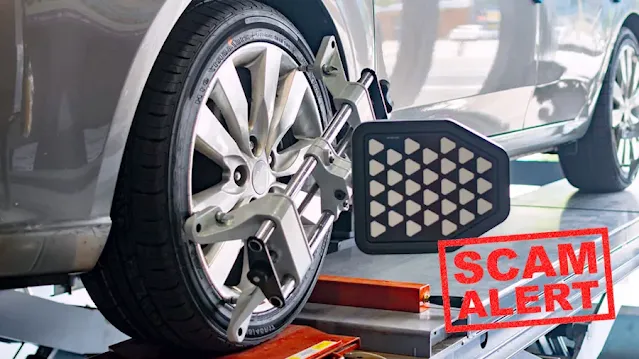
Quick Answer: Do You Need a Wheel Alignment?
You probably need a wheel alignment if your car pulls to one side, the steering wheel is crooked while driving straight, the tires are wearing unevenly, or the vehicle recently hit a curb, pothole, road debris, or had suspension work done.
You probably do not need an alignment simply because you came in for an oil change and the advisor added it to the estimate. A shop should be able to explain the reason, show tire wear, provide alignment measurements, or connect the recommendation to a real driving symptom.
Best rule: Wheel alignment is not a scam when it fixes a real steering, tire-wear, or suspension problem. It becomes an upsell when it is recommended without symptoms, evidence, or measurement proof.
| Never Use | Use Instead |
|---|---|
| Approving alignment just because the dealer recommends it | Ask for symptoms, measurements, and a before-and-after printout |
| Assuming every oil change needs alignment | Check tire wear, steering position, and driving behavior first |
| Ignoring uneven tire wear | Inspect tires before they are ruined |
| Blaming alignment for every vibration | Check tire balance, bent wheels, and tire condition too |
| Trusting a “free alignment check” blindly | Ask to see actual readings and factory specs |
Signs You Actually Need a Wheel Alignment
Most drivers do not need advanced tools to notice the biggest alignment symptoms. If the car no longer tracks straight, the steering wheel is not centered, or the tires are wearing strangely, alignment should be checked.
Real Alignment Symptoms
- Car pulls left or right: The vehicle drifts or pulls on a flat, straight road.
- Steering wheel is off-center: The wheel is crooked even though the vehicle is driving straight.
- Uneven tire wear: One edge of the tire wears faster than the other.
- Feathered tire edges: The tread feels smooth in one direction and sharp in the other.
- Recent impact: You hit a curb, pothole, parking block, or road hazard.
- After suspension work: Tie rods, control arms, struts, steering parts, or suspension repairs may require alignment.
- Vehicle wanders: The car feels unstable or needs constant steering correction.
Simple test: If your car drives straight, the steering wheel is centered, and the tires are wearing evenly, you may not need an alignment right now.
When Wheel Alignment Is a Dealer Upsell
An alignment recommendation becomes suspicious when it is treated like a routine add-on instead of a condition-based service. Some shops and dealerships recommend alignments too often because the service is profitable, easy to sell, and sounds safety-related.
Common Dealer Alignment Tactics
- Oil change upsell: The advisor recommends an alignment during every service visit even though the car drives normally.
- No printout: The shop claims the alignment is off but cannot show actual measurements.
- Vague tire warning: The advisor says your tires will be ruined without showing uneven wear.
- New tire pressure: The shop says alignment is mandatory with new tires even though your old tires wore evenly.
- Free check pressure: A free check suddenly becomes a paid alignment without clear evidence.
- No explanation: The shop cannot say which angle is out of spec or why it matters.
Upsell warning: If the dealer says you need alignment but cannot show tire wear, steering symptoms, suspension damage, or alignment readings, slow down before approving it.
| Say Yes When | Say No or Wait When |
|---|---|
| The car pulls to one side | The car drives straight |
| The steering wheel is off-center | The steering wheel is centered |
| Tires are wearing unevenly | Tires are wearing evenly |
| You hit a pothole or curb | No recent impact happened |
| Suspension or steering parts were replaced | It is only suggested during a routine oil change |
| The printout shows readings outside specification | No measurement printout is provided |
Free Alignment Check: Helpful or Upsell?
A free alignment check can be useful, but it is also one of the easiest ways to turn a “free inspection” into a paid service. The check itself measures wheel angles. It does not automatically mean you need an alignment.
The danger is when the shop uses a free alignment check as a sales tool but does not clearly show you the numbers, factory specs, tire wear, or symptoms. A good shop should be able to show which angle is out of range and whether the problem is serious enough to adjust now.
When a Free Alignment Check Is Useful
- You recently hit a pothole or curb.
- The steering wheel is crooked.
- The car pulls left or right.
- You are buying expensive new tires.
- Your old tires show uneven wear.
- You had suspension or steering parts replaced.
- You want documentation before approving a paid alignment.
When a Free Alignment Check Becomes Suspicious
- The shop says “it is out” but will not show the readings.
- The printout is missing or hard to understand.
- The recommendation appears at every oil change.
- The car drives straight and tires look normal.
- The advisor pressures you before explaining the measurements.
- The shop cannot say whether it is toe, camber, caster, or thrust angle.
- The check leads to suspension repairs without proof of worn parts.
Free check rule: A free alignment check is worth considering only if you receive clear measurements, factory specs, and an explanation of what is actually out of range.
| Free Check Result | What It Means | What to Do |
|---|---|---|
| All readings in green | Alignment is within spec | No paid alignment needed unless symptoms exist |
| Slightly out of spec, no symptoms | May not be urgent | Ask whether tire wear shows a real problem |
| Toe badly out of spec | Tires may wear quickly | Consider alignment, especially with tire wear |
| Camber out of spec | Could involve adjustment limits or worn parts | Ask whether the angle is adjustable on your vehicle |
| Shop refuses printout | Poor proof | Get a second opinion before approving work |
A free alignment check should be treated like a free car diagnostic check: useful information, not automatic permission to buy the repair.
Alignment Check vs Alignment Service
An alignment check measures the current wheel angles. An alignment service adjusts those angles back toward factory specifications when adjustment is possible. A check alone does not fix anything.
| Service | What It Does | What to Ask For |
|---|---|---|
| Free alignment check | Measures wheel angles | Ask for the printout and factory specs |
| Two-wheel alignment | Adjusts front wheel angles when applicable | Ask whether your vehicle needs four-wheel alignment instead |
| Four-wheel alignment | Measures and adjusts all four wheels when possible | Ask for before-and-after readings |
| Dealer alignment | Uses dealer equipment and factory data | Ask why dealer service is needed over an independent shop |
| Performance alignment | Uses custom specs for lowered or modified vehicles | Ask for the target specs before work begins |
Free check warning: A free alignment check is only useful if the shop gives you clear measurements. Do not approve work based only on “it is out.”
How to Read an Alignment Printout
An alignment printout usually shows before-and-after measurements. Many machines use colors to show whether each angle is within factory range. Green usually means within specification. Red usually means outside specification. But color alone is not enough. You need to know which angle is out and whether it matters for your symptoms.
Common Alignment Terms
- Toe: Whether tires point slightly inward or outward when viewed from above. Bad toe can destroy tires quickly.
- Camber: Whether tires lean inward or outward when viewed from the front. Bad camber can wear tire edges.
- Caster: Steering-axis angle that affects stability and steering return. Not always adjustable on every car.
- Thrust angle: Whether the rear wheels point straight with the vehicle centerline.
- Before readings: Measurements before the shop made adjustments.
- After readings: Measurements after adjustment.
Printout tip: Ask the advisor to circle the angles that were out of spec and explain how those readings connect to your tire wear, pulling, or crooked steering wheel.
How Much Should a Wheel Alignment Cost?
Wheel alignment cost depends on your location, vehicle type, suspension design, shop labor rate, and whether you need a two-wheel, four-wheel, dealer, or specialty alignment. A normal alignment at an independent shop is often less expensive than a dealer alignment.
| Service Type | Typical Cost Range | Best For |
|---|---|---|
| Standard alignment | $75–$125 | Many everyday cars and SUVs |
| Four-wheel alignment | $100–$175 | Most modern vehicles when all four wheels need measurement |
| Dealer alignment | $125–$250+ | Newer, complex, warranty, or brand-specific vehicles |
| Performance or lowered car alignment | $150–$300+ | Modified suspensions, custom specs, performance setups |
| Lifetime alignment plan | Varies | Drivers who keep the car long-term and use the same shop |
Is $100 for an alignment good? Yes, around $100 can be a fair price for a quality alignment at many independent shops, especially if you receive a proper before-and-after printout.
Do You Need Alignment After New Tires?
You do not always need an alignment after new tires, but it is smart to check alignment when buying expensive tires. If the old tires wore unevenly, the steering wheel is crooked, or the car pulls, an alignment can protect the new tires from early damage.
If the old tires wore evenly, the car drives straight, and the steering wheel is centered, an alignment may not be urgent unless the shop shows measurements that are out of spec.
Alignment Is Smart After New Tires If
- The old tires had inside-edge or outside-edge wear.
- The old tires were feathered or cupped.
- The car pulls to one side.
- The steering wheel is off-center.
- You recently hit a pothole or curb.
- Suspension or steering parts were replaced.
- The tire shop shows readings outside factory specs.
New tire warning: Do not let a shop say “new tires always require alignment” without showing tire wear, symptoms, or measurement proof.
What Throws Off Your Alignment?
Alignment can drift over time, but sudden impacts and worn suspension parts are common reasons a vehicle goes out of spec. If the car starts pulling after hitting something, do not ignore it.
Common Causes
- Potholes: Hard impacts can shift suspension geometry.
- Curbs: Even a low-speed curb hit can affect alignment.
- Speed bumps: Hitting them too fast can stress suspension parts.
- Worn parts: Tie rods, ball joints, bushings, struts, and control arms can affect alignment.
- Accidents: Even minor collisions can bend or shift components.
- Modifications: Lift kits, lowering kits, and tire size changes may require alignment.
- New suspension parts: Replacement steering or suspension parts often require alignment afterward.
Reality check: If alignment keeps going out repeatedly, the issue may be worn suspension parts, bent components, or tire problems — not just bad luck.
Wheel Alignment vs Tire Balancing
Wheel alignment and tire balancing are not the same service. Alignment adjusts wheel angles. Balancing corrects weight imbalance in the wheel and tire assembly.
| Problem | More Likely Cause | What to Check |
|---|---|---|
| Car pulls left or right | Alignment, tire pressure, tire pull, brake drag | Alignment readings and tire pressure |
| Steering wheel is crooked | Alignment | Toe and steering wheel center |
| Vibration at highway speed | Tire balance, bent wheel, tire defect | Wheel balance and tire condition |
| Uneven tire edge wear | Alignment or worn suspension | Camber, toe, and suspension parts |
| Car shakes after tire rotation | Tire balance or tire condition | Balance, tire wear, wheel damage |
If your car shakes after service, read Car Shaking After Tire Rotation? Check These Fixes Before Buying Tires.
How to Avoid Alignment Scams
You do not need to reject every alignment recommendation. You need to make the shop prove it with symptoms, tire wear, or numbers.
Step 1: Ask for the Alignment Printout
The printout should show before-and-after readings and identify which angles were outside specification.
Step 2: Inspect Your Tires
Look for inside-edge wear, outside-edge wear, feathering, cupping, or one tire wearing faster than the others.
Step 3: Check Tire Pressure First
Low pressure in one tire can mimic pulling or poor handling. Confirm tire pressure before blaming alignment.
Step 4: Ask What Changed
If the car drove fine last week, ask what evidence shows alignment suddenly changed.
Step 5: Ask Which Angles Are Out
The shop should be able to explain whether toe, camber, caster, or thrust angle is the problem.
Step 6: Get a Second Opinion
If a dealer recommends an expensive alignment or suspension repair, compare it with a trusted independent mechanic or tire shop.
Step 7: Do Not Ignore Real Symptoms
If the car pulls, tires wear unevenly, or the steering wheel is crooked, alignment can save money by preventing tire damage.
Scam protection rule: No printout, no symptoms, no tire wear, no recent impact, and no explanation usually means no rush.
Official Tire and Repair Resources
Related Tire and Repair Guides
If tire wear or tire damage is part of the alignment discussion, these guides can help you decide what to repair first.
Tire Wear, Flat Tires and Rotation
- Can You Patch a Tire Near the Sidewall? Safe Repair Rules Explained
- Fix Flat Tires for Free: Where to Get Free Tire Repair
- Can I Change Just One Tire? When It’s Safe vs When to Replace More
- What Happens if You Don’t Rotate Your Tires? Risks, Costs & Tips
- Tire Rotation Cost: Free Tire Rotation vs Dealer Prices
- Tire Tread Depth Legal Limit: When Worn Tires Get You in Trouble
Tire Service Problems and Missing Parts
- Car Shaking After Tire Rotation? Check These Fixes Before Buying Tires
- Missing Wheel Lock Key After Tire Rotation? Don’t Drive Until You Read This
- Missing a Lug Nut After Tire Rotation? Don’t Drive Until You Read This
- EV Tire Wear: Why Electric Cars Wear Tires Faster & How to Make Them Last
- Why New Cars Are Ditching Spare Tires: Key Insights
Repair Scams and Dealer Upsells
- Dealer Maintenance Upsells: Services You May Not Need
- Car Repair Estimate Red Flags: 11 Charges That Should Make You Pause
- Car Repair Scams: Real Signs You’re Being Ripped Off
- Why Is My Car Repair Estimate So High?
- Repair Shop Parts Markup: Fair or Rip-Off?
- Free Car Diagnostic Test: What Stores Check
Bottom Line
Wheel alignment is a real service when your vehicle pulls, the steering wheel is crooked, tires wear unevenly, or you recently hit something or had suspension work done. It is not something you should approve automatically at every oil change.
Before paying: Ask for symptoms, tire-wear evidence, a measurement printout, factory specs, and before-and-after readings. No proof usually means no rush.
Frequently Asked Questions FAQ’s
Do I need a wheel alignment regularly?
No, wheel alignments are not needed at every oil change. Check alignment when the car pulls, the steering wheel is off-center, tires wear unevenly, suspension parts are replaced, or you hit a pothole or curb.
How do I know if my car needs a wheel alignment?
Common signs include pulling to one side, a crooked steering wheel while driving straight, uneven tire wear, feathered tire edges, or handling changes after hitting a curb or pothole.
Is a wheel alignment a dealer scam?
Not always. Wheel alignment is a real service when symptoms or measurements show it is needed. It becomes suspicious when a dealer recommends it with no printout, no tire wear, no symptoms, and no explanation.
Are free alignment checks worth it?
Free alignment checks can be useful if the shop gives you the actual measurement printout. Be careful if the check immediately turns into a paid service without showing which readings are outside specification.
Is it really necessary to get a wheel alignment?
Yes, when the vehicle is out of alignment. It can protect tires, improve handling, and correct pulling or steering issues. Without symptoms or measurement proof, it may not be necessary right away.
Is wheel alignment actually worth it?
Wheel alignment is worth it when your tires are wearing unevenly, the car pulls, or the steering wheel is off-center. It is not worth paying for repeatedly when the vehicle drives straight and the tires wear normally.
How much should a full alignment cost?
A full wheel alignment commonly costs about $75 to $175 at many shops, while dealers and specialty vehicles may cost more. Ask for a before-and-after printout to confirm the work was actually performed.
Do I need an alignment after getting new tires?
It is smart to check alignment when installing new tires, especially if the old tires wore unevenly. If the old tires wore evenly and the car drives straight, an alignment may not be urgent unless the shop shows measurements out of spec.


